



Survey responses from 28 participants engaged in different activities of the OrganicTargets4EU project provide insight into what motivates stakeholders to participate, what they value most, and where participatory processes can improve.
Who participated
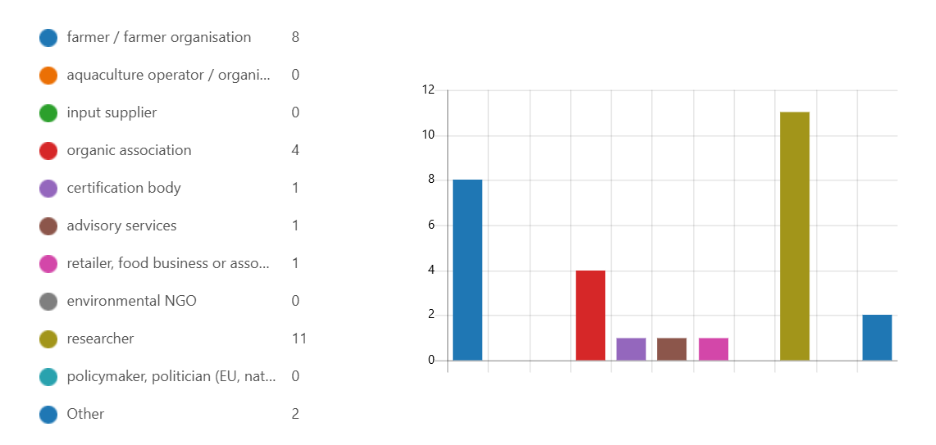
Respondents were primarily researchers (11) and farmers or farmer organisations (8), with smaller representation from organic associations (4) and individual actors from certification, advisory services, and food-sector organisations. No responses were received from policymakers, environmental NGOs, input suppliers, or aquaculture stakeholders. Thus, findings mainly reflect perspectives from research and primary production communities rather than the full stakeholder ecosystem.
Figure: Stakeholder representation
Participants represented a geographically diverse sample. Countries reported are shown in the graph below.
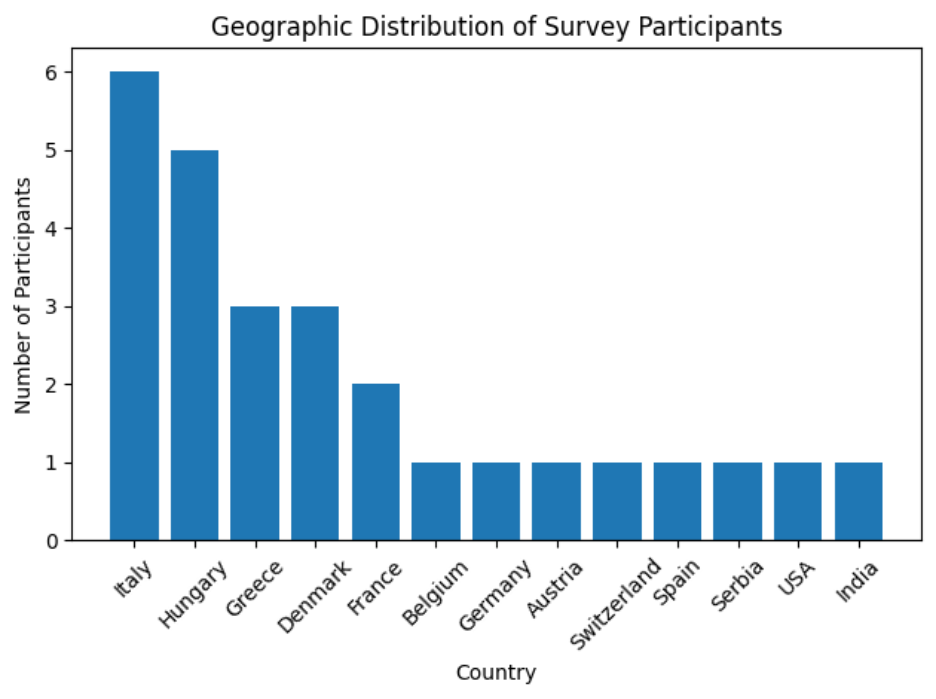
This distribution indicates broad international reach, though participation intensity varied considerably across countries.
Gender distribution showed a moderate imbalance (18 men, 10 women). Overall, the sample reflects perspectives mainly from technically engaged stakeholders already connected to research or sector networks.
Motivations for engagement
Across responses, stakeholder motivations clustered into three consistent drivers:
- Learning and knowledge acquisition – gaining information on legislation, research, methodologies, sector challenges, and future scenarios.
- Exchange and networking – meeting other actors, sharing experiences, and engaging in cross-country dialogue.
- Influence and contribution – shaping strategic goals, policies, or sector development.
Many participants emphasised intellectual and professional benefits such as learning new approaches, discovering experts, or gaining strategic insight. Some expressed normative motivations, including strengthening organic farming or reducing environmental impacts. These findings suggest that participation in OrganicTargets4EU was driven primarily by cognitive, relational, and strategic incentives rather than financial ones.
Perceived value of participation
Overall experiences were rated very positively (average 4.36/5), with particularly high scores for inclusiveness (4.61/5) and gender awareness (4.57/5). Most respondents reported that participation met their motivations fully or partly, and none indicated unmet expectations.
Engagement was also considered useful for participants’ own work (4.14/5). However, the likelihood of consulting project resources in the future was slightly lower (3.93/5), suggesting that stakeholders valued the participatory experience itself somewhat more than long-term output use.
What stakeholders value most
A clear pattern emerged regarding which activities and outputs stakeholders found most useful.
Most valued
- workshops and collaborative exchanges
- dialogue with diverse stakeholders
- practical knowledge resources (fact sheets, deliverables, policy briefs)
Moderately valued
- newsletters and website news
Least valued
- passive formats (slides, social media content)
- administrative processes
- highly theoretical perspectives
Interactive formats dominated perceptions of value. Stakeholders consistently highlighted discussion, co-creation, and peer exchange as the most useful aspects of participation. Concise and actionable written outputs were preferred over visually engaging formats such as videos, indicating that professional relevance outweighs presentation style.
Compensation needs and incentives
Direct references to financial compensation were rare; only one respondent explicitly mentioned monetary incentives. Instead, responses show that stakeholders perceived several non-financial benefits as forms of compensation:
- access to knowledge
- networking opportunities
- recognition and visibility
- influence on sector development
- professional learning
These findings suggest that participation incentives within OrganicTargets4EU were largely intrinsic and professional rather than financial. Monetary compensation may still matter for some actors—particularly practitioners or organisations with limited resources—but it was not the primary driver for most respondents.
Limitations and barriers identified
Several structural constraints should be considered when interpreting the findings.
First, the sample size was small (n=28), which limits statistical generalisation and means results should be interpreted as indicative rather than representative.
Second, some respondents participated in only one activity, reducing their ability to compare different engagement formats.
Third, certain stakeholder groups were absent from the respondent sample, indicating that perspectives from parts of the policy, value-chain, and civil society ecosystem are not captured in the survey.
Finally, individual responses highlighted logistical barriers such as limited travel funding, as well as occasional lack of clarity regarding activity objectives. These suggest that participation constraints may relate more to access and communication than to activity quality.
Best practices for participatory project design
The OrganicTargets4EU experience highlights several characteristics associated with successful stakeholder engagement:
- interactive formats, especially workshops and collaborative sessions
- inclusion of diverse perspectives
- clear relevance to practice or policy
- opportunities for stakeholders to contribute expertise
- high-quality, practical outputs
- inclusive facilitation environments
Figure: Which outputs the participants found the most useful
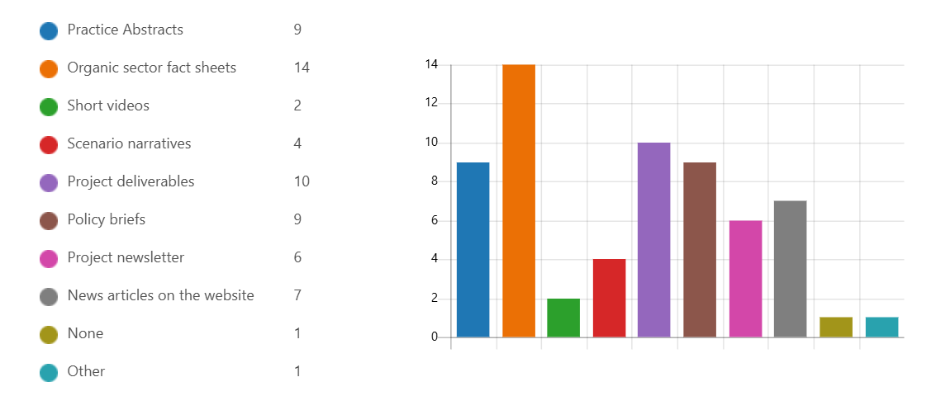
Activities combining these elements were consistently perceived as meaningful, useful, and motivating.
Room for improvement
Suggestions for improvement were limited but consistent:
- involve a broader range of stakeholder groups
- increase frequency of engagement
- provide logistical or financial support where needed
- ensure clarity of objectives and communication
These recommendations indicate that engagement approaches themselves were effective, but that reach and accessibility could be strengthened.
Conclusion
Findings from the OrganicTargets4EU stakeholder survey indicate that participants perceived involvement as valuable when it enabled learning, exchange, and influence. Interactive engagement formats and practical knowledge outputs were the strongest drivers of perceived value, while passive dissemination activities were less appreciated. Financial compensation played a secondary role compared to intellectual, relational, and strategic benefits, though it may still facilitate participation for some actors.
Overall, results suggest that participatory EU projects such as OrganicTargets4EU can achieve high stakeholder satisfaction when they prioritise dialogue, relevance, and inclusiveness. Remaining challenges relate primarily to ensuring broad access, diverse representation, and sustained engagement across stakeholder groups. Addressing these structural dimensions will be key to strengthening both effectiveness and equity in future participatory research and innovation initiatives.